
SBS
A year and a half after the launch of this series of KSIS articles, one observation can be made: that almost half of the cases identified involve children. Today is still an example of this, then we go back in time once again to discover the tragic story of LEE HYEONGHO, who disappeared and was assassinated when he was only nine years old.
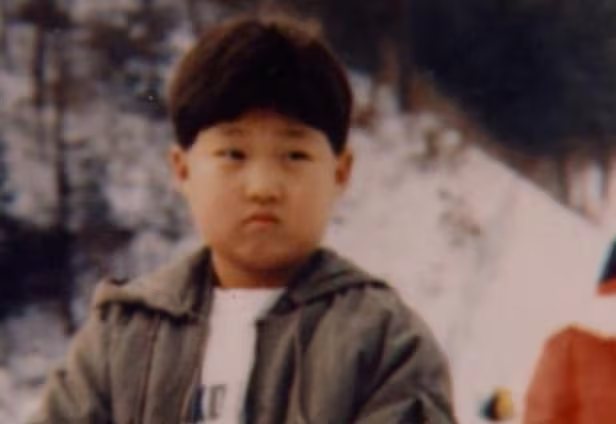
Apgujeong is a quite quiet residential area of Seoul, known today for its trendy cafes and chic shops. It is however there, in a playground for children, that the young HYEONGHO was kidnapped on January 29, 1991, without leaving any trace. Thus begins a game of cat and mouse, between the parents terrified to have lost their son and the kidnapper, a man identified as being in his thirties. Only three hours after the kidnapping, which took place around 6 PM, the man makes a phone call to the family, asking for a ransom of 70 million won (about 44.500€) as well as a car with a landline telephone inside it.
Then, in the space of two weeks, 60 calls were made.
It was with the help of this car with a built-in phone that the kidnapper could not be traced by the police, and the detectives conducting the investigation. Initially, it had been agreed that the father of the family would bring the car with the money to the parking lot at Gimpo airport, before taking a bus home while the criminal came to pick up the car. However, fearing to be intercepted by the police, he did not show up at the appointment, but somehow witnessed it, because during another phone call to the father, he complained about the presence of the police around. Indeed, in the trunk of the car, there was an undercover detective hidden and waiting to trap the kidnapper.
The car was therefore moved to another place, at the man’s request, but two other people who passed by in the corner saw the money on the front seat and tried to steal it, before being apprehended by the police who thought they were the real culprits. Once again angry, the kidnapper ordered the family to stop involving the police, under which they would never see HYEONGHO again.

As it seemed complicated for the man to recover the money in person, he decided to open a bank account specially for the occasion under the name of YOON JEONGSOO and another under the name of KIM JOOSUN, in order to cover his tracks. Following an umpteenth call, he told the little boy’s mother-in-law to go to a specific place where she would find a piece of paper in a bin with the bank account numbers on it, in order to make a transfer of 20 million won to each one, lowering the total ransom to 40 million won, or €25,500. The police advised her, however, to pay only half as a precaution, then investigating to find the true owner of the accounts.
The man, discovering the involvement of the law enforcement once again, gave an ultimatum to the family, demanding that they deposit the remaining money in a bag under a Seoul bridge, with a note left where it was supposed to be. The police being aware, they still couldn’t catch the criminal, who left with the bag and decided to cut all ties with the parents when they discovered that the bills were counterfeit. On February 13, the last call was made.
On February 19, a man sought to recover the money in the bank account, but despite being cut off from his actions by an agent of the bank, he was able to flee. At the time, since surveillance cameras were not as widespread as they are now, we never found the trace of the kidnapper. Furthermore, it was also not necessary to give his fingerprints to open a bank account, making this track also null.
It is then that on March 13, around noon, a small body is found in a sewage drainage channel, lifeless.

HYEONGHO had his limbs tied. His eyes, nose, and mouth, held together by tape. After being assaulted, he reportedly died of asphyxia, unable to breathe because of the adhesive tape. The autopsy revealed that he had been assassinated on the day of his disappearance based on the remains of food in his stomach, highlighting the psychological torture that the criminal caused to the parents, keeping them hopeful when they would never see their son again.
It was upon the discovery of the body that the investigation became public, the police looking for possible witnesses in the case. Two people then said to have seen the boy with a man in his twenties, betraying the image that was made of him on the phone when he was ten years older. After further research, the leads regarding these two testimonies were dismissed. The National Institute of Forensic Science asked to retrieve the audio tapes of the phone calls, in order to analyze the murderer’s voice.
« I want to know why you did that. If you need money, I will give it to you, but apologize to HYEONGHO and then I will forgive you » — HYEONGHO‘s father

Plot twist: the voice of the criminal corresponds to the voice of HYEONGHO’s cousin, who was 29 years old at the time of the events. It is said that he would have a tumultuous relationship with the boy’s father after he divorced his mother. The cousin noticed the distress of his aunt who found herself in a precarious situation without money decided to avenge her. He also complained that HYEONGHO’s grandfather cut off his aunt’s income after the divorce, as he was the richest of the family. Being a member of the family, the child would probably not have been wary and would have followed his cousin, leading to his kidnapping afterwards.
The cousin, however, brought the alibi as being in Gyeongju that day, a city in the southeast of Korea, which was confirmed thanks to the testimony of another person, whom the police suspected of lying to protect him. But due to lack of incriminating evidence, he was released. Even if the voice seemed to be the same as that of the kidnapper on the phone, this technique is not infallible and therefore cannot have the same weight to accuse someone.
It was then learned that a detective might have apprehended the killer when he had tried to recover the car, but because he was afraid of being noticed and in danger, preferred not to follow him. Thus, this case is not resolved to date, and the limitation period expired in 2006. The hypothesis was also put forward that two people were involved in the kidnapping, but this track could not be further examined. A further analysis of the voice was carried out in 2001, and determined that the cousin was not the author.
During the show ‘I WANT TO KNOW THAT‘ broadcast in 2011, it was insisted on the fact that potentially there wasn’t one guilty person, nor two, but maybe in reality three: one for the calls, an accomplice for the alibi, and one to try to recover the money and the car. The suspect, becoming multiple, can therefore very well be a close relative of the child or his family after all. Different portraits were made based on the description of the bank’s agent, as well as analysts who estimated the shape of the face of the caller based on his voice height and diction, portraits that diverged on several points such as the length of the face and the jaw for example.

Furthermore, a crucial detail was pointed out: on the phone, the criminal always expressed himself with the help of ‘we’ and not ‘I’. Thus, the cousin could have made the calls from Gyeongju, while others would have acted on Seoul. As for the differences noted in the voice between the cousin and the calls, it was assumed that he could have worn a mask to camouflage his voice. Since the culprit was never found, HYEONGHO’s father sank into alcoholism, feeling guilty for not having been able to help his son.
In 2007, PARK JINPYO directed the film ‘Voice of a Murderer‘, talking about this story. Third most profitable film that year in Korea, some details have been modified (such as the ransom amount increasing to $100,000), but still seems faithful in the chronology of events. At the release of the film, the director declared:
« I hope he [the criminal] will watch the movie, that he knows that we do not forget his actions » —PARK JINPYO
He wanted to make this story known in order to show the absurdity of such a short limitation period for cases concerning minors. He nevertheless deemed it necessary to ask for the parents’ agreement before making the film, and had the right to use the original soundtracks of the calls. In the end, there was nothing left as proof other than these soundtracks. No fingerprints, no DNA, no surveillance videos, nothing.

In total, the calls made by the killer lasted 1h25, but since the statute of limitations has passed, this investigation is and will remain forever closed without follow-up, an umpteenth cold case sadly marking Korea.
Journalist : Pillet Anaïs
Sources: KSTATION TV, sous les photos


