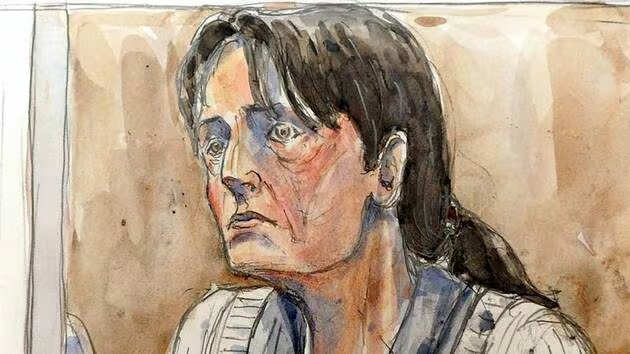
AFP
We think that the closest person to our entire existence is our mother, that nothing can shake the maternal relationship between a woman and her child, so what happens when the one in whom we must have the most trust commits the irreparable?

The case of frozen babies… It is not a singular affair, because it has already made the headlines of several countries, when the world discovers babies, dead and hidden in freezers and fridges. When one of these cases creates a bridge between France and Korea, things get out, evolving around a single name: VÉRONIQUE COURJAULT.
It was in Parnay, France, that VÉRONIQUE FIEVRE was born in October 1967. She meets JEAN-LOUIS COURJAULT as they grow up and after both getting married, they have two sons born in 1995, JULES and 1996, NICOLAS. Then, the couple’s work bearing fruit, the family moves abroad, regularly changing countries to suit the professional needs of the parents. In 2002, the COURJAULT family decided to settle in Seoul, JEAN-LOUIS having found a job at Renault Samsung Motors as an engineer. They therefore drop off their luggage in the residential area of Seocho-dong.
Everything is going well for the four COURJAULT for several years, taking their marks in the South Korean peninsula and its capital which is full of secrets and crazy animations. Not a shadow on the table, until 2006 when the family returns to France for the summer holidays. JEAN-LOUIS must, however, make a brief round trip to Korea for work, and it is with dread that while going home, the house being still locked after their departure, he discovers the bodies of two babies in a plastic bag, in the garage freezer. Panicked, he calls the police, and the case breaks out.
« I opened [a drawer] and I see a white bag. I open it with my hands and I see that there is something surrounded in a towel. I half-open it, and I see a hand » — JEAN-LOUIS COURJAULT
The first thing that the police do is a DNA test, and while the family gathered in France, the results come out: the babies are indeed COURJAULT‘s. A month after the discovery of the bodies, the parents hold a conference in Tours, France where their second home is located, and deny the results by even advancing the possibility that it was a setup against the family, on the part of a Korean company that would not appreciate international competition in its territory. When the Korean police went to the couple’s home, they took DNA samples from the couple’s bathroom after noticing the presence of two dead babies in towels, placed in bags in the freezer.
In Korea, the investigation makes a lot of noise, in a country where family, balance and reputation reign. For the father of a family, it is impossible to see reality in person; if his wife had been pregnant twice, he would have inevitably noticed it! But against all odds, in September 2006, VÉRONIQUE COURJAULT admits everything. She admits to being the mother of the babies, but above all, to having killed them, but what scared the most the column is that the woman recognizes three murders…

A medical examination is commissioned, where the mother of the family is diagnosed with repeated denials of pregnancy. A denial of pregnancy is characterized by the absence of the usual signs of pregnancy, when the mother does not recognize or is unaware of expecting a child. No physical signs often suggest that the mother is pregnant; no weight gain, the belly does not grow, and periods are often still there. Without genuine awareness, the pregnancy can persist, until full term, which happened for VÉRONIQUE. Childbirth then arrives suddenly, and one suffers more the event than one experiences it, lost in a feeling of astonishment and dissociation.
« It was as if it wasn’t me. I saw myself doing without understanding » — VÉRONIQUE COURJAULT
In some more extreme cases, new mothers commit infanticide, shocked by discovering they are pregnant and not knowing how to react. This is what was held against VÉRONIQUE COURJAULT during the trial held in France in June 2009. Although judged for murder on minors under 15 years old, denial of pregnancy was recognized as a mitigating factor. However, the repetition of the facts, including three murders, did not plead in her favor. She revealed that the three infants were born between 1999 and 2003, so the first one was born in France before the couple’s move to Korea.
She will confess to having killed and frozen the two babies born in Seoul at their birth in September 2002 and December 2003, while another was burned in the family chimney in July 1999 when the couple were still living in France. One of the murders having been committed in France, and the family being of French nationality, that is why the Korean authorities have decided to transmit the file to the French magistrates for the trial and the sentence pronounced. The Criminal Court of Indre-et-Loire condemns VÉRONIQUE to 8 years in prison, but she will be released after serving half of her sentence for good conduct.
« It is then estimated that her detention should not be extended by more than a few months, having spent nearly three years in pre-trial detention » — Criminal Court
JEAN-LOUIS was initially indicted for complicity in murder, but was finally acquitted when it was considered that he had never been informed of his wife’s pregnancies. Doctor DANIEL SCHECHTER, a child psychiatrist in Geneva, speaks of denial of pregnancy as being a form of dissociated suffering, and after the pleading of VÉRONIQUE’s lawyer, the premeditation for infanticides was not retained. The newspaper ‘Le Figaro‘ described the act of the mother as having choked the babies, just after delivering them a crouch in a bathroom, and torn the umbilical cord.

We dive into the tormented past of VÉRONIQUE COURJAULT, growing up in the heart of a family of seven children. Although she did not suffer from verbal or psychological violence in her childhood, she acknowledges feeling choked among her brothers and sisters, while her mother sometimes asked her to take care of them. She did not see herself raising a large family in her turn. She wished to offer a more warm environment to her children, and denying pregnancy would have revealed flaws as a mother that she would not have known how to admit. Against all odds, her entourage described her as a loving and caring mother.
« Childhood banally dull, marriage flatly gloomy, adult existence unfortunately unfulfilled, serious husband who does not satisfy her » – « Le Figaro »
The daily life of the COURJAULT family was simple, but far from idyllic for a fragile woman. She who was facing a life sentence finally received a lenient sentence, too much according to the French and Korean press. The family promised, in 2006 when the case broke out, not to return to Korea, but reactions were not long in coming. In Korea, children are as if sacred. Too few in a society in perpetual evolution, the crimes surrounding them are just as rare – although addressed via the KSIS -. VÉRONIQUE COURJAULT deeply shocked the country, how can a mother kill three of her babies in cold blood, by facial compression?
The media highlighted the multicultural aspect of the case, and especially pointed out that denials of pregnancy are much rarer in Korea than in the West, medical follow-ups being more systematic in the peninsula. Upon her release on May 17, 2010, VÉRONIQUE was prohibited from speaking to the media, as closing the case of frozen babies. Upon hr release from prison, her husband, JEAN-LOUS COURJAULT, who patiently waited for his wife’s release, indicated that he wished to resume a normal life and in happiness.

The mother-in-law of VÉRONIQUE also spoke on the radio to express the happiness of the family reunited again, wishing them to turn the page to move forward and rebuild after these tragic events. Throughout the trial, the mother of the family did not hide her act, and even seemed to be ashamed of it, failing to explain the reasons that led her to the murders. The only thing she said was:
« Since this child was mine, I granted myself all the rights over him, even the extreme right to give him death » —VÉRONIQUE COURJAULT
She continued, explaining that she had not felt them move or grow within her, and that in a way, it was not children she had killed, explaining having hidden them in the freezer because she did not know what to do with them. Gradually, the spectre of the infants left her mind, so much so that she eventually forgot their presence in the garage. Nevertheless, a psychiatric expertise establishes that VÉRONIQUE was not suffering from a pathology that abolished his discernment. In short, she was fully aware of her actions.
The case, in addition to its international impact, allowed to highlight in a serious way the phenomenon of denial of pregnancy, and its repercussions on a large scale. In the context of VÉRONIQUE COURJAULT, we would talk more about denial of pregnancy: becoming aware of pregnancy, but remaining in denial and not wanting to face reality. The freezing of the babies allowed all the genetic fingerprints affixed to their bodies to be preserved, which makes it possible to make VÉRONIQUE’s guilt evident.

Apart from the shock of Korean society, the country’s press somehow tried to explain the denial in which JEAN-LOUIS was plunged, having never noticed his wife’s pregnancies. He was then accused of being fickle, and of inviting women – even prostitutes – during the absence of his wife and children, without any substantiated evidence. Among the Korean media that reported on the case, NEWS1 and KBS gave the most interest, KBS even making a show about denial of pregnancy. In Korea, they talked about “서래마을 영아 사건/유기” being “the case of the infants of Seorae Maeul “, French neighborhood of Seoul where the family lived.
The residence where the family lived in Seoul being equipped with a video surveillance system, it was not possible for VÉRONIQUE to dispose of the bodies like the first one, burned one evening in the fireplace while the rest of the family slept, the ashes thrown into the garden. Plus, a caretaker in charge of selective waste sorting would inevitably have noticed if one or more infants had been thrown into plastic bags.
Going back to the birth of the first COURJAULT child, it is explained that the parents got married upon learning about VÉRONIQUE’s pregnancy. This phenomenon does exist in Korea, where one speaks of ‘shotgun wedding’, when one seeks to clear their honor by marrying the girl they have gotten pregnant. Among the celebrities, there was a lot of talk about the unexpected marriage between MOON HEEJUN from the group H.O.T, and SOYUL from CRAYON POP, as internet users found it hard to believe this unusual union.
While VÉRONIQUE did not want a large family, unlike JEAN-LOUIS, the couple recognized as having forgotten contraceptive pills. Having become infamous in Korea and France, the memory of these serial infanticides will leave an indelible mark, following simple oversights. Rather than uttering a cry for help, a plea for help, a mother in distress chose to commit the inseparable, which was nevertheless forgiven by her husband and relatives, including her parents.

Ten years later, in 2018 and 2019, a woman – a Korean – confesses having killed her two babies by strangulation, before placing them in the refrigerator of her house, and she also received in 2024 an 8-year sentence for murder and body concealment. The case was inevitably linked to that of VÉRONIQUE COURJAULT, but also to the phenomenon of ‘ghost babies’; children not declared at birth. Indeed, more than 2,000 children were not declared according to an article from the ‘Korea JoongAng Daily‘ between 2015 and 2022. Most of these children would have been at the heart of crimes or shortcomings within poor households, making it difficult to identify their exact number, as it is often complicated to trace those who may have died from this phenomenon through infanticide, or abuse.
The case of the two infants killed by a Korean woman led to a reform of the Penal Code in Korea: the notion of infanticide, as well as child abandonment, was revised and then removed from the Code to strengthen the criminal protection of new-born, because being previously a legal category with lighter penalty. It reminds us that, despite the horror of certain cases, they manage to make a country’s society move in spite of themselves and reform it in order to protect other people, or children, who may one day be confronted with the same situation.
What do you think of this case, highly publicized in France? Do you consider that the trial and the sentence should have taken place in Korea, where the bodies were discovered? Give us your opinion in the comments without further ado!
Journalist : Pillet Anaïs
Sources : KSTATION TV, under pictures


